A load center is the horizontal distance from a forklift’s fork face to the load’s center of gravity. It may sound like a small measurement. It is not. A longer load center can reduce a truck’s lifting capacity, even when the load’s weight stays unchanged. A pallet that is deeper than expected, or a heavy item placed near its front edge, can shift that center and affect stability.
The risk is documented. The U.S. National Institute for Occupational Safety and Health (NIOSH), in its 2001 alert Preventing Injuries and Deaths of Workers Who Operate or Work Near Forklifts, estimated that forklift incidents caused about 100 worker deaths and 20,000 serious injuries each year. Those figures are historical estimates, not current annual totals, but they show why careful load assessment matters. OSHA’s powered industrial truck requirements also direct operators to follow the truck’s rated capacity and manufacturer’s instructions. Check the capacity plate; it may list different limits for different load centers or attachments.
How to calculate the load center for safe lifting begins with measuring the load’s depth and locating its center of gravity. For a uniformly distributed load, divide its depth by two, then measure from the fork face to that midpoint. For example, a 48-inch-deep, evenly loaded pallet has a 24-inch load center. Uneven loads need closer assessment. The geometric midpoint may not be the true center of gravity. That is an easy detail to overlook. Use the equipment manufacturer’s capacity information, and do not assume a calculation alone confirms a safe lift. A quick measurement helps; a verified capacity makes the decision dependable.
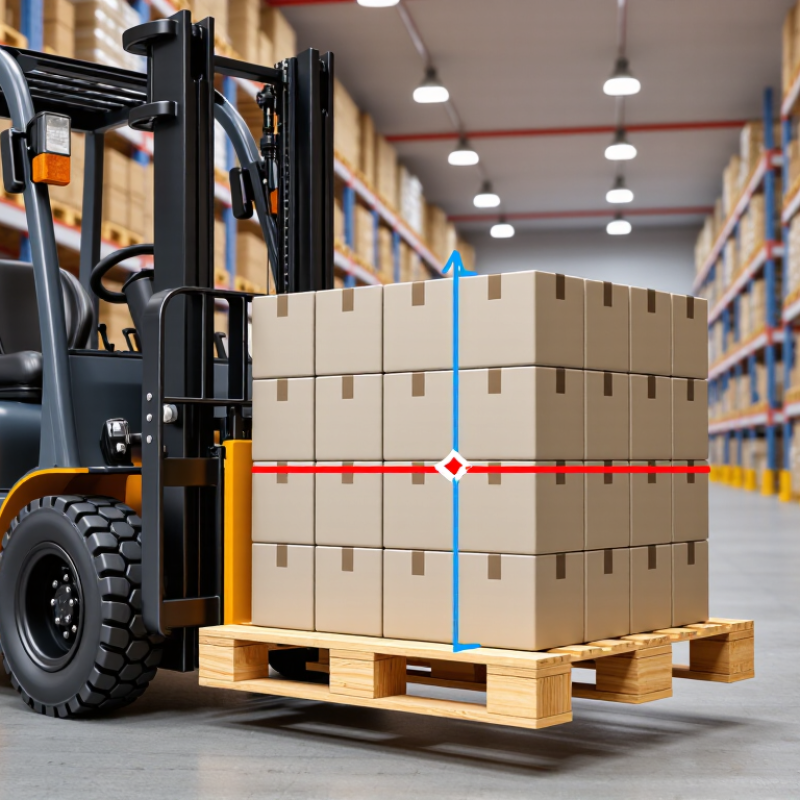
What Is Load Center and Why Does It Matter in Lifting?
The load center is the horizontal distance from a forklift’s fork face to the load’s center of gravity. A common rating uses a 24-inch load center, but the capacity plate for the specific truck is the authority. A pallet may look evenly stacked, yet dense items near its front shift the center forward. That shift matters. The farther the load sits from the front wheels, the greater the overturning moment.
A simple check is load weight multiplied by load-center distance. For example, 2,000 pounds at 24 inches creates 48,000 inch-pounds of moment. The same weight at 30 inches creates 60,000 inch-pounds. That is a 25% increase. Do not treat this calculation as permission to exceed the truck’s rated capacity; attachments, mast height, and load shape also affect stability. Check the capacity plate and the manufacturer’s load chart before lifting.
This is not a minor edge case. OSHA’s Powered Industrial Trucks eTool reports that forklift overturns account for about 25% of forklift-related deaths. A forward-shifted load can reduce the stability margin, especially when turning or lifting high. Keep the load close to the mast. Uneven pallets need extra attention. In practice, estimating the center by eye can be unreliable; pause and reposition the load when its contents are unclear.
A load center is the horizontal distance from the vertical face of the forks to the load’s center of gravity (CG). For a uniformly distributed load, the CG is typically halfway along its depth. An off-center or uneven load may have a different CG.
| Example load | Load weight | Load depth on forks | CG position from fork face | Load moment (weight × load center) |
Illustrative screening result* |
|---|---|---|---|---|---|
| Evenly distributed pallet load | 1,800 kg | 1,000 mm | 500 mm | 900,000 kg·mm | Below the reference moment |
| Evenly distributed long load | 1,600 kg | 1,200 mm | 600 mm | 960,000 kg·mm | Below the reference moment |
| Evenly distributed long, heavy load | 1,800 kg | 1,200 mm | 600 mm | 1,080,000 kg·mm | Above the reference moment |
| Load with its CG shifted toward the fork tips | 1,400 kg | 1,200 mm | 700 mm | 980,000 kg·mm | Below the reference moment |
| Short load that exceeds the truck’s stated capacity | 2,200 kg | 800 mm | 400 mm | 880,000 kg·mm | Exceeds the reference capacity |
*Illustrative calculation only: examples use a hypothetical truck rated for 2,000 kg at a 500 mm load center, equivalent to a reference moment of 1,000,000 kg·mm. A moment calculation is a screening aid, not a substitute for the truck’s capacity plate or manufacturer load chart. Confirm the actual load weight and CG, attachments, lift height, and operating conditions before lifting; never exceed the manufacturer’s rated capacity.
It is the horizontal distance from the fork face to the load’s center of gravity. Measure along the forks, not across the load’s width.
Measure its front-to-back depth and divide by two. A 1,200 mm-deep crate has a nominal center 600 mm from the fork face when evenly positioned.
Yes. Dense parts stacked at one end can shift the center forward. A tape measure cannot reveal hidden weight distribution.
An attachment adds distance between the fork face and the load. Include that offset when checking the load center and truck capacity.
Compare its rated load center and capacity with the measured load and planned lift height. If the setup differs, check the manufacturer’s capacity chart.
A screening estimate is rated capacity × rated load center ÷ actual load center. It is not permission to lift; attachments and load shape can reduce capacity.
It moves the load’s weight farther forward, increasing the overturning moment. Small shifts matter.
Raising a load, turning, or braking can shift the combined center of gravity. Keep the load close to the mast and travel with forks low.
Do not assume the load is centered. Pause, review reliable weight information, and ask a qualified supervisor or lift planner. A neat-looking pallet can still be uneven.
A load center is the horizontal distance from a lifting machine’s load-bearing surface to the load’s center of gravity. It matters because increasing this distance can reduce the machine’s safe lifting capacity and affect balance. To determine it, identify the load’s dimensions and weight distribution, then locate the center of gravity. For a uniformly shaped, evenly weighted load, the center of gravity is generally at its midpoint; uneven loads require a more careful assessment.
How to calculate the load center for safe lifting: measure from the load’s bearing edge or fork face to its center of gravity, keeping the measurement direction consistent with the equipment’s capacity information. Before lifting, compare the measured load center and load weight with the machine’s rated capacity for that configuration. Keep the load stable, centered, and as close to the lifting surface as practical, and do not exceed the applicable capacity. If the load’s center of gravity or weight is uncertain, pause and obtain a reliable assessment before proceeding.

 Neto Forklifts